In 2026, choosing the right platform for your business is crucial, and the decision between Pimcore vs WordPress can significantly impact your digital transformation journey.
Pimcore and WordPress serve different purposes, with Pimcore offering an all-in-one solution for enterprises by combining CMS, PIM, DAM, CDP, and eCommerce capabilities.
On the other hand, WordPress remains a popular choice due to its ease of use, extensive plugins, and cost-effectiveness, especially for small to medium-sized businesses.
Centric, as a leading digital solution provider, helps businesses navigate this choice by offering tailored recommendations based on their unique needs.
We understand the complexities of both platforms and assist companies in selecting the best option to optimize their content management, product data, and customer experiences.
The comparison of Pimcore and WordPress is highly relevant for businesses in 2026, as organizations must choose a platform that not only meets their current needs but can also scale with future growth.
Whether you are looking for enterprise-grade solutions or a simpler CMS, making the right decision now will set the foundation for long-term success.
This blog delves into the differences between Pimcore vs WordPress in 2026, offering an in-depth comparison of both platforms.
This guide is essential for companies looking to optimize their digital strategies, whether they're focused on enterprise-level solutions or simpler, more cost-effective options.
What is Pimcore and WordPress?
Pimcore is an open-source digital experience platform (DXP) that combines several powerful tools into one unified system. It includes a content management system (CMS), product information management (PIM), digital asset management (DAM), customer data platform (CDP), and eCommerce capabilities.
Pimcore is designed for enterprises and large-scale businesses, offering robust features for managing complex data, multiple websites, and personalized customer experiences.
Its flexible, API-driven architecture allows businesses to scale seamlessly and integrate with other enterprise systems like ERP and CRM.
WordPress, on the other hand, is the most widely used content management system (CMS) globally, powering over 40% of websites.
Originally designed for blogging, WordPress has evolved into a versatile platform for creating a variety of websites, including blogs, portfolios, business sites, and online stores.
Known for its ease of use, WordPress offers a user-friendly interface and a vast plugin ecosystem, making it accessible to both developers and non-technical users. With options like WooCommerce, it also provides eCommerce functionality, although it may not scale as well as Pimcore for larger enterprises.
What is Pimcore?
Pimcore is an open-source Enterprise Digital Experience Platform (DXP) built to help organizations manage complex digital ecosystems from a single, unified system.
Unlike traditional content management systems, Pimcore goes beyond website publishing. It provides a centralized framework where businesses can control content, product data, digital assets, and customer information efficiently.
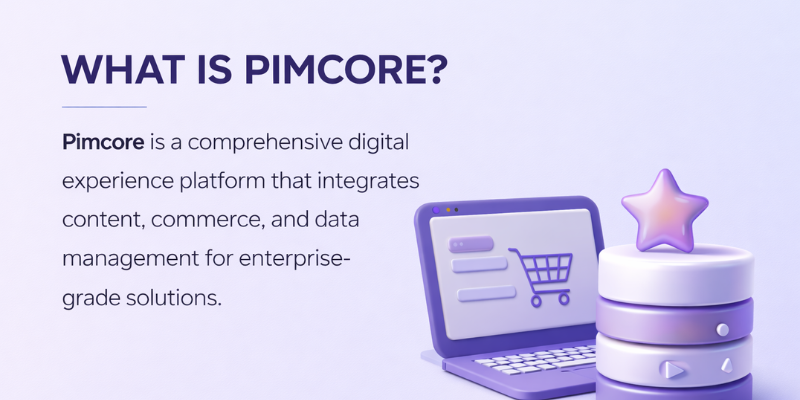
What makes Pimcore stand out is that it combines CMS, PIM, DAM, CDP, and eCommerce capabilities into one powerful platform.
Instead of using multiple disconnected tools, enterprises can streamline operations, improve data consistency, and create seamless digital experiences across all channels.
Here are some of the key features of Pimcore
Data Management: Product Information Management (PIM) & Digital Asset Management (DAM)
Pimcore includes a built-in PIM system that centralizes product data such as specifications, pricing, descriptions, and attributes. This ensures consistency across websites, marketplaces, apps, and print catalogs. Its DAM functionality allows businesses to organize, manage, and distribute digital assets like images, videos, and documents with structured metadata and version control.
Scalability: Designed for Enterprises
Pim solutions are built with scalability in mind. It supports multi-language, multi-site environments and large product catalogs, making it ideal for enterprises operating globally.
Integration Capabilities
With its API-driven architecture, Pimcore integrates seamlessly with ERP systems, CRM platforms, digital marketing tools, and other third-party applications. This ensures smooth data flow and unified digital operations across the organization.
Explore Our Product Information Management Services
What is WordPress?
WordPress is the world’s most popular Content Management System (CMS), powering more than 40% of all websites globally. It started in 2003 as a simple blogging platform, but over the years, it has evolved into a powerful, all-purpose website development solution.
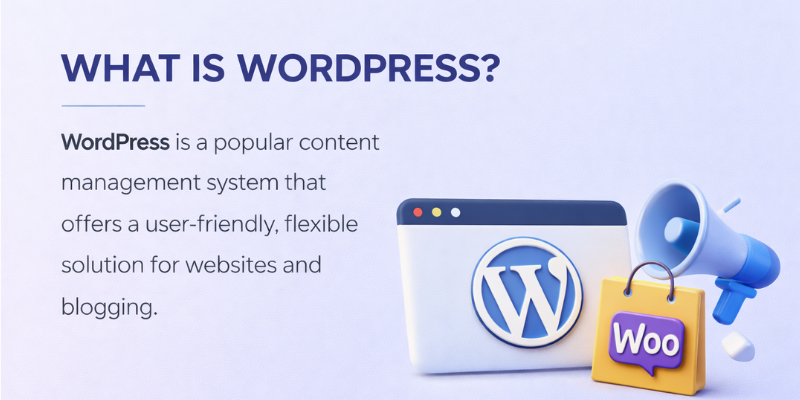
Today, WordPress is used to build business websites, e-Commerce stores, portfolios, news portals, membership sites, and even enterprise-level platforms.
Its flexibility and open-source nature have made it a preferred choice for startups, small businesses, and even large organizations that want control over their website without heavy development complexity.
Here are some of the key features of WordPress
Easy-to-Use for Non-Developers
One of WordPress’s biggest strengths is its user-friendly dashboard. Even users with little or no coding knowledge can create pages, publish blog posts, upload media, and manage website content easily.
Large Plugin Ecosystem
WordPress offers thousands of free and premium plugins that extend its functionality. From SEO tools and security enhancements to eCommerce and marketing automation tools, plugins allow businesses to customize their websites without building everything from scratch.
Great for Content-Driven Websites
WordPress excels in content publishing. It provides intuitive content editing, role-based permissions, scheduling features, and strong SEO compatibility, making it ideal for blogs, corporate websites, and marketing-focused platforms.
Pimcore vs WordPress: Feature-by-Feature Comparison
When evaluating Pimcore vs WordPress, it’s important to look beyond popularity and focus on functionality.
From content management to product data handling and digital asset organization, both platforms serve different business needs.
Let’s break down the comparison feature by feature.
|
Feature Area |
Pimcore |
WordPress |
|
Content Management System (CMS) |
Enterprise-grade Pimcore CMS designed for structured, large-scale environments. Supports complex workflows and governance. |
User-friendly CMS ideal for blogs, business websites, and content-driven platforms. Simple and intuitive interface. |
|
Multi-Site & Multi-Language |
Built-in multi-site and multi-language management for global enterprises. |
Possible through plugins and configurations, but not natively enterprise-focused. |
|
Content Workflows |
Advanced publishing workflows with approval chains and structured data models. |
Basic role-based access and content scheduling features. |
|
Product Information Management (PIM) |
Native, built-in Product Information Management (PIM) system for centralized product data management. |
No native PIM. Requires WordPress PIM plugin or WooCommerce extensions. |
|
Product Data Accuracy |
Ensures single source of truth across eCommerce, marketplaces, apps, and print. |
Product data managed via plugins; may lack advanced governance and multi-channel sync. |
|
PIM for WooCommerce |
Supports enterprise-level integration for managing product data centrally and pushing to WooCommerce. |
Basic catalog management through WooCommerce; limited for large enterprise needs. |
|
Digital Asset Management (DAM) |
Built-in DAM with advanced metadata, versioning, and structured asset organization. |
Basic media library; extended DAM functionality requires plugins. |
|
CMS vs PIM Capability |
Combines CMS vs PIM vs DAM vs CDP in one unified platform (DXP approach). |
Primarily a CMS; additional capabilities depend on third-party plugins. |
|
Scalability |
Designed for enterprises with large product catalogs and global operations. |
Suitable for small to medium businesses; scaling requires optimization and additional tools. |
|
Integration |
API-driven architecture; integrates with ERP, CRM, and third-party systems. |
Integrates via plugins; not inherently enterprise integration-focused. |
Why Choose Pimcore for Your Business in 2026?
As businesses move toward digital maturity in 2026, the debate around Pimcore vs WordPress becomes more strategic than technical.
Enterprises are no longer just looking for a CMS; they need a unified ecosystem that connects content, product data, assets, and customer intelligence. This is where Pimcore positions itself as a long-term, scalable solution.
Here are some of the key reasons why Pimcore can be the right choice for your business in 2026.
Enterprise-Level Scalability and Customization
For organizations comparing Pimcore CMS with traditional platforms, scalability is often the deciding factor. Pimcore is built for complex enterprise environments that demand flexibility, integration, and structured data management.
-
How Pimcore Supports Large Enterprises
Pimcore supports large enterprises through its flexible API integrations, customizable workflows automation, and enterprise-grade architecture. Its modular structure allows businesses to adapt the platform to specific operational needs rather than adjusting processes to fit the software.
With seamless integration into ERP, CRM, and third-party systems, Pimcore becomes more than just a CMS. It acts as a central data hub within a broader DXP ecosystem, making it ideal for companies managing global websites, multi-channel commerce, and large product catalogs.
-
Advanced Features for Product and Data Management
Unlike platforms that rely on plugins, Pimcore offers native Product Information Management (PIM) capabilities. It enables streamlined product catalogs, structured pricing management, and efficient customer data collection in one centralized system.
This makes Pimcore particularly powerful in the PIM vs CMS discussion. Businesses managing thousands of SKUs across multiple markets benefit from a single source of truth, ensuring data accuracy, consistency, and faster time-to-market.
-
Improved Customer Experience with Pimcore
Modern enterprises understand that digital success depends on delivering personalized and seamless user experiences. Pimcore combines CMS, PIM, DAM, and CDP capabilities to create unified customer journeys across channels.
-
Personalized Experiences with CDP
Pimcore’s built-in Customer Data Platform (CDP) collects and unifies customer data from multiple touchpoints. This enables businesses to segment audiences, personalize content, and launch targeted successful marketing campaigns based on real behavioral insights.
In the evolving PIM vs CDP vs DXP landscape, Pimcore stands out by integrating customer intelligence directly with content and product data, allowing enterprises to deliver tailored digital experiences at scale.
-
Optimized Digital Asset Management
Pimcore’s advanced Digital Asset Management (DAM) system ensures optimized media handling across websites and eCommerce platforms. Teams can manage high-resolution images, videos, and marketing materials with structured metadata and version control.
Compared to traditional headless CMS platforms, Pimcore’s centralized DAM improves collaboration, maintains brand consistency, and enhances overall content performance. For enterprises prioritizing both operational efficiency and customer experience in 2026, Pimcore provides a future-ready digital foundation.
Check Our Digital Asset Management Services
Why Choose WordPress for Your Business in 2026?
While enterprise platforms dominate large-scale digital ecosystems, WordPress continues to be a strong choice for businesses that prioritize simplicity, speed, and cost efficiency.
In the ongoing Pimcore vs WordPress discussion, WordPress stands out for accessibility and flexibility, especially for startups and growing businesses.
Ease of Use and Accessibility
One of the biggest reasons businesses choose WordPress in 2026 is its ease of use. Compared to enterprise-level platforms, WordPress offers a simplified experience that requires minimal technical expertise.
-
User-Friendly Platform for Non-Developers
WordPress provides a quick setup process and an intuitive dashboard, making it accessible even to non-developers. Teams can create pages, publish blogs, and manage content without writing code.
Its role-based access system supports smooth collaboration between administrators, editors, and authors. For businesses comparing Pimcore CMS vs WordPress CMS, WordPress often wins in terms of simplicity and ease of publishing.
-
Cost-Effective for Small to Medium Businesses
WordPress has a lower initial cost and requires fewer technical resources to maintain. The open-source core is free, and hosting options are widely available at affordable rates.
For small and medium businesses evaluating product information management WordPress solutions, WordPress combined with WooCommerce can provide a budget-friendly starting point. While not as advanced as enterprise PIMcore WordPress integration, it remains practical for businesses with limited catalogs and operational complexity.

Extensive Plugin Ecosystem
Another major advantage in the Pimcore vs WordPress comparison is WordPress’s massive plugin ecosystem. It allows businesses to extend functionality without custom development.
-
The Power of WordPress Plugins
WordPress offers thousands of plugins that expand its capabilities far beyond a traditional CMS. Businesses can integrate tools for analytics, automation, CRM connectivity, and even install a WordPress PIM plugin for managing product data.
Popular plugins enhance SEO, social media integration, security, and performance optimization. For companies exploring WooCommerce PIM or lightweight product catalog management, plugin flexibility makes WordPress adaptable to different business needs.
SEO Capabilities with WordPress
SEO remains a key factor for online growth in 2026, and WordPress has built a strong reputation in this area.
-
SEO-Friendly Features of WordPress
WordPress is structured to support search engine optimization through clean URLs, customizable permalinks, and structured content hierarchy. Plugins like Yoast SEO and RankMath simplify metadata management, keyword optimization, and readability analysis.
Compared to more complex enterprise systems, WordPress makes on-page SEO accessible to marketing teams without technical intervention. For content-driven businesses focused on organic visibility rather than enterprise PIM vs CMS architecture, WordPress remains a strong SEO-friendly choice.
Pimcore vs WordPress for eCommerce: Which is Better?
When evaluating Pimcore vs WordPress for eCommerce in 2026, the decision largely depends on catalog size, operational complexity, and long-term growth plans.
Both platforms can support online stores, but their architecture and scalability differ significantly.
Let’s explore how each performs in the e-commerce landscape.
Pimcore's eCommerce Capabilities
For enterprises managing complex product ecosystems, Pimcore offers a more structured and scalable approach compared to traditional CMS-based stores.
-
Enterprise-Grade eCommerce Framework
Pimcore provides an enterprise-grade eCommerce framework designed for advanced catalog management, dynamic pricing structures, and multi-channel integration. Businesses can manage thousands of SKUs, regional pricing models, and multilingual product data within one centralized system.
With its built-in Product Information Management (PIM) and Digital Asset Management (DAM), Pimcore ensures consistent product data across websites, marketplaces, and mobile apps.
This makes it ideal for organizations comparing Pimcore vs Shopify, Pimcore vs PrestaShop, or other enterprise-level commerce solutions.
-
Pimcore with WooCommerce
Through Pimcore WordPress integration, businesses can connect Pimcore’s powerful PIM system with WooCommerce. In this setup, Pimcore manages structured product data and digital assets, while WooCommerce handles front-end transactions.
This hybrid Pimcore WooCommerce model ensures centralized data governance while leveraging WordPress’s familiar publishing environment.
For enterprises exploring PIM for WooCommerce at scale, this integration offers better data accuracy and workflow control than standalone WordPress setups.
WordPress and WooCommerce
WordPress, combined with WooCommerce, remains one of the most popular eCommerce solutions globally due to its simplicity and affordability.
-
WooCommerce Plugin for WordPress
WooCommerce is a powerful plugin that transforms WordPress into a fully functional online store. It is a simple and cost-effective solution for small to medium eCommerce businesses.
With additional plugins, businesses can extend functionality for payments, shipping, analytics, and even lightweight WordPress PIM plugin capabilities. For startups and growing brands, WooCommerce offers flexibility without heavy enterprise infrastructure.
-
Limitations for Scaling Large Catalogs or High-Traffic Stores
While WooCommerce works well for smaller stores, it can face performance and management challenges when handling very large product catalogs or high traffic volumes.
Advanced multi-channel synchronization and structured product governance are limited compared to enterprise platforms.
For organizations debating CMS vs PIM vs DXP or considering long-term scalability, Pimcore often provides stronger data architecture.
However, for businesses prioritizing affordability and quick deployment, WooCommerce remains a practical entry point into eCommerce.
Scalability: Which Platform Will Grow With Your Business?
When comparing Pimcore vs WordPress, scalability is a critical factor for long-term success. A platform that works well today must be able to support future expansion, higher traffic, larger product catalogs, and more complex integrations.
Let’s explore how both platforms perform as your business grows.
Scalability of Pimcore
Pimcore is built for enterprise-level scalability, making it a strong choice for businesses planning aggressive digital growth.
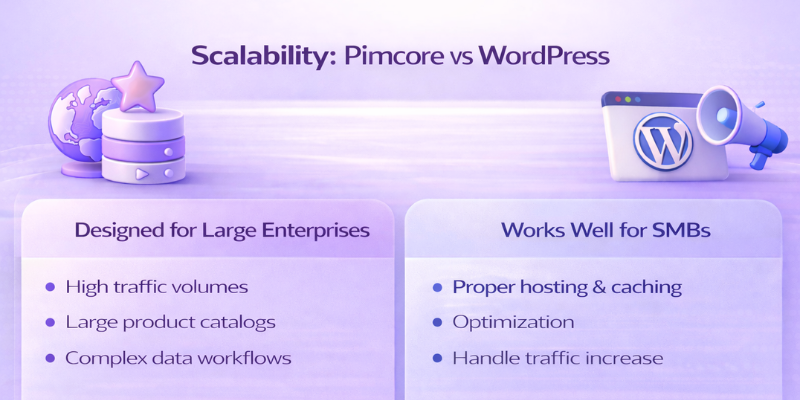
Designed for Large Enterprises
Pimcore is designed to handle:
-
High traffic volumes
-
Large product catalogs
-
Complex data workflows
Its structured data modeling and built-in Product Information Management (PIM) capabilities ensure that the platform remains stable even when managing thousands of SKUs across multiple regions.
This makes Pimcore ideal for businesses that require centralized governance and scalable solutions, such as when comparing Pimcore vs Drupal, Pimcore vs Inriver, or other enterprise-grade platforms.
Flexibility for Customization and Growth
Pimcore follows an API-driven architecture, which allows businesses to integrate systems such as ERP, CRM, marketing automation tools, and other third-party platforms.
This flexibility ensures that as your digital ecosystem expands, Pimcore can grow with you, adapting seamlessly. It stands out in the PIM vs DXP conversation by combining scalability with data consistency, enabling enterprises to modernize their digital infrastructure without relying on external plugins.
Scalability of WordPress
WordPress also offers scalability, but its approach differs significantly from Pimcore’s enterprise-first model. It is best suited for small to medium-sized businesses (SMBs) and content-driven websites.
Works Well for SMBs and Small Websites
WordPress performs exceptionally well for SMBs. With proper hosting, caching, and optimization, it can handle increasing traffic and expanding content needs.
However, scaling WordPress for more advanced Product Information Management (PIM) requirements or multi-channel commerce typically requires additional plugins and third-party tools.
Challenges for Large Enterprises
While WordPress can scale, it faces challenges for large enterprises:
-
Structured workflows
-
Centralized data governance
-
Integrated CMS vs DAM vs PIM capabilities
For enterprises with very large product catalogs, WordPress PIM plugins can become complex and performance-heavy.
WordPress requires significant optimization, custom development, and plugin management. In comparison, Pimcore provides a more structured, future-ready solution that is better suited for businesses planning enterprise-level expansion.
FAQs
What are the key differences between Pimcore and WordPress?
Pimcore is an enterprise-level Digital Experience Platform combining CMS, PIM, DAM, and CDP in one system. WordPress is primarily a CMS focused on website eCommerce capabilitiespublishing. Pimcore suits complex, large-scale operations, while WordPress is ideal for content-driven and smaller websites.
Can WordPress be used as a PIM system?
WordPress does not have built-in Product Information Management. It relies on a WordPress PIM plugin or WooCommerce extensions. These work for small catalogs but lack enterprise-level scalability and structured data governance.
Is Pimcore suitable for small businesses?
Pimcore is mainly designed for enterprises with complex workflows and large product catalogs. Small businesses may find WordPress more practical due to its simplicity, lower cost, and easier setup.
What are the e-Commerce capabilities of Pimcore vs WordPress?
Pimcore offers an enterprise-grade eCommerce framework with integrated PIM and DAM. WordPress uses WooCommerce, which is cost-effective and flexible but may face limitations when scaling large or complex online stores.
Conclusion
Choosing between Pimcore vs WordPress ultimately depends on your business size, complexity, and long-term digital goals. If your organization requires enterprise-grade scalability, centralized product data management, advanced workflows, and seamless integration with ERP or CRM systems, Pimcore stands out as a powerful all-in-one Digital Experience Platform.
It is particularly suitable for enterprises managing large product catalogs, multi-language websites, and complex data ecosystems.
On the other hand, WordPress remains the ideal choice for startups, small to medium businesses, and content-driven websites.
Its ease of use, quick setup, extensive plugin ecosystem, and cost-effectiveness make it a practical solution for businesses focused primarily on content publishing and marketing.
The right platform is not about popularity it’s about alignment with your business strategy. Centric brings deep expertise in both Pimcore and WordPress, helping organizations evaluate their needs and implement scalable solutions. With the right guidance, businesses can build a future-ready digital foundation that supports sustainable growth well beyond 2026.